
Are you working to pay the bills, chasing the next title, or drawn to something more?
Over the course of our lives, many of us will spend around 90,000 hours working. That’s equivalent to 2,250 working weeks, or roughly 46 years of full-time employment. How we experience these working hours, weeks and years can be drastically different from person to person. A big influence on our experience of work is our motivation behind it and the value we are seeking from it.
Research by organizational psychologist Dr. Amy Wrzesniewski and colleagues highlighted that people typically think of their work as falling into one of three main orientations - a job, a career or a calling (Wrzesniewski et al., 1997; Wrzesniewski, 1999). Understanding these orientations can help us clarify which one we most relate to, which orientation we most want, and how we can make better work decisions that are aligned with the experience we would like to have.
If you feel drawn to something more than paying the bills and chasing the next title, it’s worth reading on.
A job - A means to an end
People with a job orientation primarily value the work for what it provides them financially. A job is seen as a means to an end which is to secure income to support life outside of work. This could include paying rent, buying groceries, paying for education, and pursuing hobbies. Meaning, enjoyment and a person’s sense of self are typically pursued more outside of work, rather than in it.
Example - Daniel (retail shelf stocker)
Daniel works at a local supermarket where he replenishes products on the shelves, organizes displays and assists customers to find items they are looking for. He doesn’t mind the work and enjoys the physical movement and the process of maintaining a tidy store. However, the job isn’t a major part of how he defines himself and if the option were there to take something better-paying with similar hours, he would take it. His work enables him to earn money, pay his bills, pay his rent and to pursue his interests outside of work. These interests include spending time with his girlfriend, playing football with friends, and the occasional weekend trip away.
A career - A ladder of progression
People with a career orientation view work as an opportunity for continual growth and progression. They are often striving for a promotion, upskilling their knowledge and skills, and working towards more senior roles. Markers of success for them include career progression, status and recognition, professional development, increasing responsibilities and growing income.
Example - Sarah (lawyer)
Sarah is a lawyer at a large commercial law firm. Here, she advises businesses on contracts and complex legal matters. She enjoys the intellectual challenge the work provides as well as working hard to achieve good outcomes for her clients. Since joining the firm, Sarah has deliberately sought opportunities to work on high-profile cases, develop her legal expertise, and build relationships with senior partners. The hours are long and demanding, but she is willing to do them as she desires to keep growing and progressing in her career. Sarah is motivated by continual growth and progression, strengthening her reputation in her field, increasing her salary, and working towards becoming a partner one day.
A calling - An extension of who you are
People with a calling orientation experience their work as inherently meaningful and fulfilling in itself. This is because the work is personally meaningful, socially valuable, or both - aligning with their values, interests, natural capacities and causes they feel connected to. It allows them to express who they are through their work and what they most care about.
Example - Jasmine (physiotherapist)
Jasmine works as a physiotherapist at a community health clinic, helping people recover from injuries and manage long-term physical conditions. She became interested in rehabilitation after watching her father regain his ability to walk after a serious car accident. This experience gave Jasmine a deep interest in human resilience and recovery, where and she couldn’t stop herself from reading books and watching YouTube videos on these topics. Jasmine has always been a naturally empathetic and patient person, with a great aptitude for practical problem solving. Her combined natural capacities and deep interests make her particularly well suited for her work as a physiotherapist. What she enjoys most in her work is helping people to return to activities that matter to them, whether that be playing with their grandkids or walking independently to the shops. Her work has its challenges, including some patients progressing more slowly and the repetitive nature of treatment at times. But the feeling of meaning, connection and contribution she experiences through her work leaves her feeling very fulfilled.
A simplified summary of these three orientations:
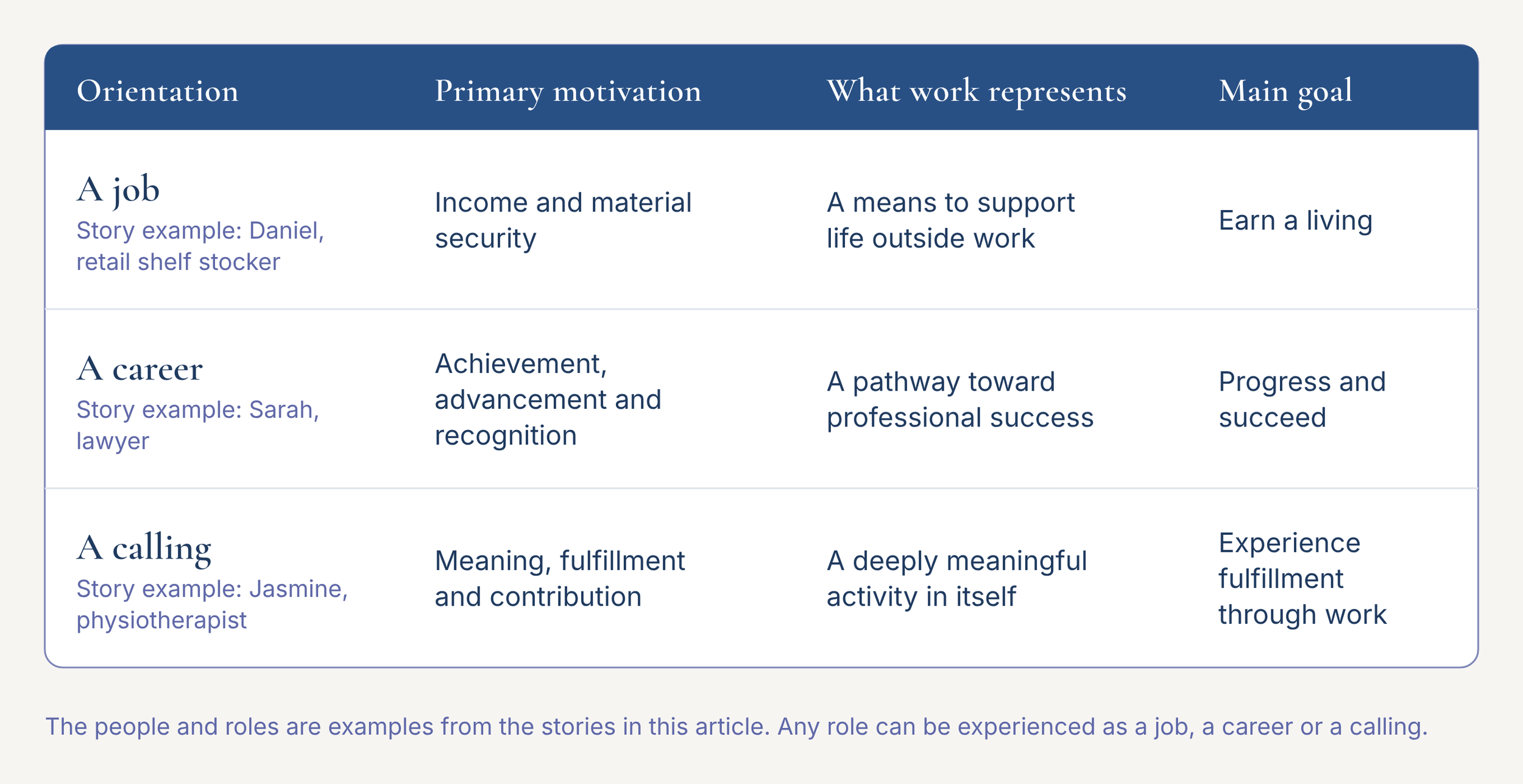
The above are three broad orientations to work. It’s worth noting that they are not mutually exclusive. A person with a career orientation will still value meaning and fulfillment through work. A person with a calling orientation will still value income to support other areas of their life. So it’s best to think of work orientations as the relative importance people place on the driving motivations for working. What are they most seeking from the work they are doing?
It’s also possible for a person to want different things out of different work roles simultaneously. For example, a person in a full-time retail job, who sees it purely as a means for obtaining income, may choose to pursue their calling in music by playing in a band on weekends and practicing outside of work. A person with a calling orientation working as a social worker may work at a cafe on weekends to supplement income, with one role more oriented to their calling and the other more as a job.
A person’s primary work orientation may also change over time. For example, it’s not uncommon for a young person to complete a number of jobs in their teens and early 20s, work to build their career in their 20s and 30s, and eventually reach a point where they want more out of their work - deeper fulfillment, purpose, alignment with who they are, and to live their calling. This has been my own personal journey.
What a calling actually means
Calling as a term is more nuanced than a job or a career. The main reason for this is that it means different things to different people. For one person, it might mean finding their passion in life, something they love doing such as playing the piano, building a business, or running a restaurant. For another person, it might mean doing meaningful work that improves people’s lives and benefits the wider society. For another, it might be more religious or spiritual in nature, where they take on a responsibility or task given to them from a higher power such as God. These differing views make it hard to land on a universally agreed definition. However, as the research continues to grow, the underlying themes associated with the term ‘calling’ continue to strengthen the clarity around what it is and how to live one.
One of the most comprehensive reviews of research on calling was conducted by Shoshana Dobrow and her colleagues (Dobrow et al., 2023). This was a meta-analysis of 201 studies on calling. Building on earlier research, they highlighted two related types of calling - an internally focused calling and an externally focused calling.
Internally focused calling
This is where a person experiences work as deeply enjoyable, personally meaningful, and a positive absorbing experience. Think of a person getting into flow state with an activity they deeply enjoy. The work is intrinsically satisfying and connected to their passions, interests, natural abilities and identity. When people say “find your passion” and “do what you love”, this is the type of calling they are referring to. The work is still work, but it is work they deeply enjoy which allows them to express their authentic selves.
Example - James (architect)
From a young age, James has always been fascinated by how buildings and spaces can influence the way people move, feel and interact. Growing up, he would sketch different layouts for his family home, imagining how these options could improve the experience of living there. He has always had a natural ability to visualize spaces in three dimensions and see how the different elements fit together. Now as an architect, he loves exploring design possibilities, experimenting with materials, and finding solutions to complex spatial challenges. He can spend hours refining a design, becoming completely absorbed in the process which both energizes and excites him.
Externally focused calling
This is where the need for a person’s work originates beyond themselves. They feel called to the work from something outside of themselves, such as a need in the world they feel particularly connected to, guidance from a higher power, or a pull to a particular path they feel they are destined for. This type of calling is associated with a feeling of duty, responsibility or service to a need in the world they feel called to.
Example - Rebecca (social worker)
Rebecca became interested in social work while helping her younger brother Mark navigate the challenges of living with a developmental disability. She saw first-hand how difficult it was to access appropriate services and how often people with disabilities were excluded from decisions affecting their own lives. These experiences impacted Rebecca deeply, creating an enduring desire for her to help address inequality and barriers that prevent people with disabilities from fully participating in society. Today, she supports adults with disabilities to access services, advocates for their rights, and empowers them to make more decisions that affect their lives. Her deepest motivation comes from believing everyone deserves the right to autonomy, dignity, and the opportunity to shape their future.
Combined internally and externally focused calling
The above two examples depict what an internally focused and externally focused calling can look like. However, it’s also possible to have a combination of both, which is the fullest expression of a calling. A combined internally and externally focused calling is one in which work is both personally meaningful, aligning with a person's deep interests and natural capacities, and connected to a greater purpose that benefits others.
Example - Tom (renewable energy engineer)
Tom has been fascinated by how energy can be generated, stored and transferred ever since he began playing with small electrical circuits as a teenager. He quickly picked up how mechanical and electrical systems interact, was able to visualize the flow between them, and found ways to improve a design before others even noticed a potential problem. Today he works as a renewable energy engineer. Previously, he worked as an oil and gas mechanical engineer. He decided to make the switch to renewables as he saw the growing effects of climate change and the world’s dependence on fossil fuels. This concerned Tom, because he wanted a world where the environment would stay clean and healthy for his kids and future generations to enjoy. Tom finds deep satisfaction in doing work which he both loves and is aligned with a purpose of creating a world that is more sustainable.
How I define a calling
Building on the research from Dobrow et al. (2023) and the examples above, I have taken a calling that combines both types as the foundation for the definition I use at CallingCraft:
“A personally meaningful and socially valuable direction for one’s work”
Personally meaningful points inward, to a person’s values, interests and natural capacities. Socially valuable points outward, to the needs or challenges in the world they feel called to address. A calling that holds both is, to my mind, its fullest expression.
It’s important to note that it is a direction, not a job title or a single role. This distinction is worth exploring further.
A calling is more than a single work role
A calling is bigger than any one job title. With the calling examples above, there is a deeper purpose motivating each person. For an internally focused calling, this is to express who they are - their interests, values, and the activities they enjoy doing. For an externally focused calling, this is to meet a need in the world they feel called to help with. The work role provides them an opportunity to express this underlying purpose, however, their calling could also be expressed in other work roles. For example:
James, who is currently an architect, could still express his deep interest in how physical spaces influence how people move, interact and feel and his natural capacity to visualize three-dimensional spaces in roles such as an interior designer, landscape architect or an urban designer.
Rebecca, who is currently a social worker and feels called to help people with disabilities exercise their rights, overcome barriers and gain greater control over their own lives, could also express this purpose through other roles such as a disability rights advocate, special education teacher or a human rights officer.
Tom, who is currently a renewable energy engineer, could still express his natural capacities and deep interests around energy storage and pursue his purpose of creating a more sustainable world through other roles such as being a clean energy technology researcher, sustainable technology inventor, or a renewable energy systems consultant.
As you can see, different roles can become ways of expressing a calling, rather than a calling being confined to a single job title. This means a calling can continue to evolve and be pursued throughout a person’s life, even as individual jobs come and go.
The benefits of a calling
Living a calling has numerous benefits that have been increasingly documented in scientific research over the last 20 years. Two meta-analyses that documented these benefits are:
Calling and the Good Life: A Meta-Analysis and Theoretical Extension by Dobrow et al. (2023) - which synthesized 201 studies involving 185,857 individuals
Exploring the Impact of Work as a Calling on Career Development: A Meta-Analytic Review (Guo et al., 2025) - which synthesized 90 studies involving 50,009 individuals
These studies linked a calling to three main categories of benefits: in work itself, in your career, and in life beyond work.
In work itself
Greater meaning: Experiencing work as deeply meaningful, important and worthwhile. (Dobrow et al., 2023)
Greater engagement and involvement: Feeling more energized, enthusiastic, dedicated and involved in work. (Dobrow et al., 2023)
Higher job satisfaction and enjoyment: Experiencing more satisfaction, enjoyment, pride, and a sense of personal accomplishment from work. (Dobrow et al., 2023)
In your career
Greater career clarity and confidence: Having a clearer sense of career direction, greater confidence in making decisions, and less uncertainty around career choices. (Dobrow et al., 2023; Guo et al., 2025)
More proactive career development: More likely to take initiative in developing and managing their career, and actively growing their skills and knowledge. (Guo et al., 2025)
Greater career persistence: Stronger commitment to their chosen direction and greater persistence in pursuing their goals, even through setbacks (Guo et al., 2025)
In life beyond work
Greater psychological well-being: A feeling of flourishing, meaning and purpose in life, and a stronger sense of belonging. (Dobrow et al., 2023)
Greater life satisfaction and happiness: Greater levels of life satisfaction, positive emotions, and better subjective wellbeing. (Dobrow et al., 2023)
Lower psychological and physical strain: Lower levels of burnout, emotional exhaustion, anxiety, depression, and other indicators of distress. (Dobrow et al., 2023)
One important caveat to these benefits - while the growing evidence continues to link calling to positive outcomes, it is not without its potential challenges. A strong sense of calling can sometimes lead people to overwork, make excessive personal sacrifices or remain in unhealthy working conditions because they are deeply committed to what they are doing (Bunderson & Thompson, 2009). In addition, simply recognizing a calling is much less strongly associated with benefits than actually living it out through your work (Duffy et al., 2013).
The CallingCraft Method aims to address both. It provides a structured framework to help people identify their calling and take deliberate, considered steps toward living it. The Method also includes a tool to help people assess and monitor their working conditions across areas such as Vitality (having the energy to sustain your work over time), Agency (having meaningful control over how you work) and Integrity (working in alignment with your values and ethics), so people can pursue their calling without losing sight of their well-being.
Two paths to the benefits
Dobrow et al. (2023) found that internally and externally focused callings are associated more strongly with certain benefits, although there is crossover.
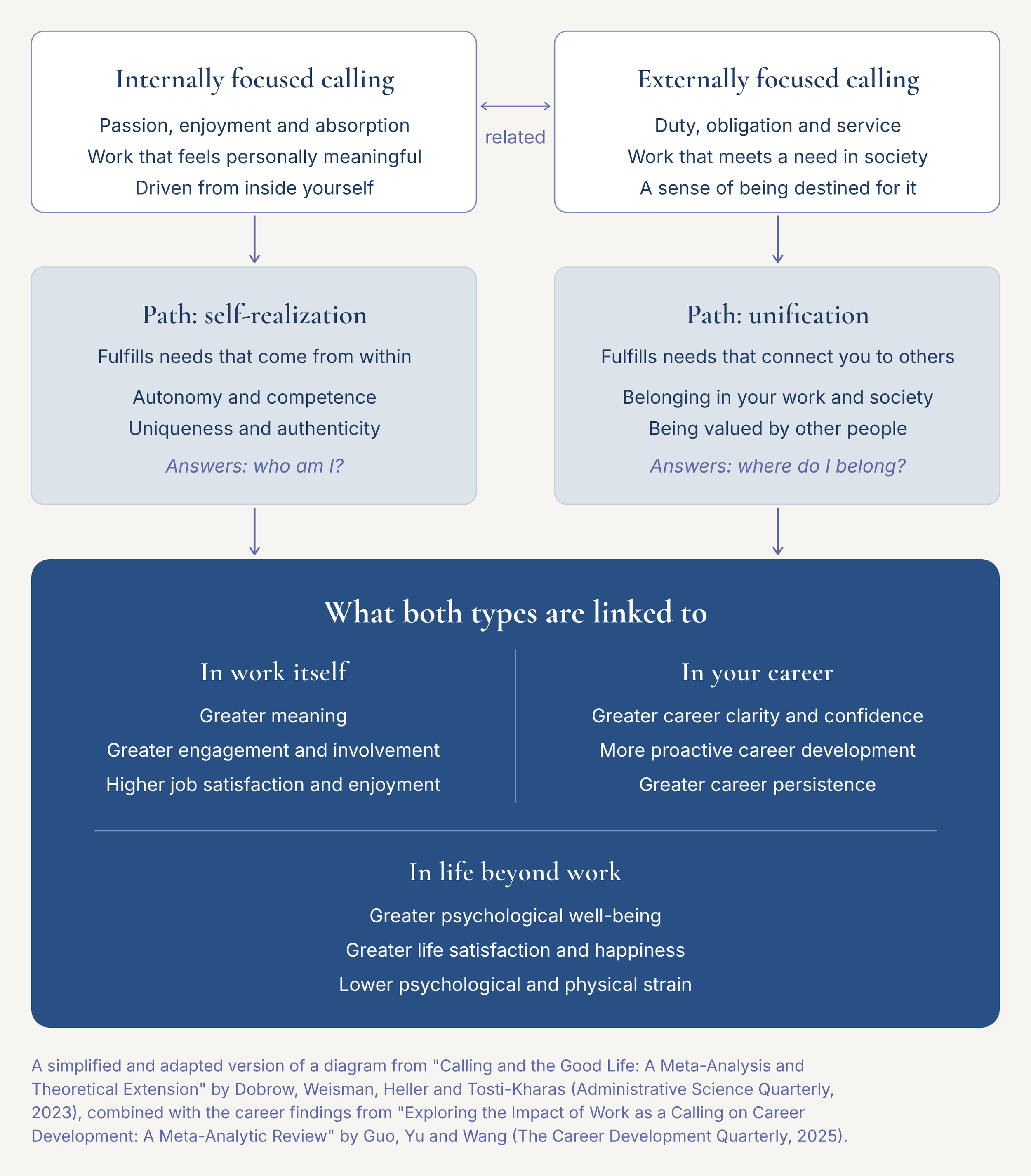
Internally focused callings are more closely linked to passion, enjoyment and absorption at work. The authors name this the path of ‘self-realization’, where a person is expressing who they authentically are. This path helps answer the question “who am I?”
Externally focused callings are more closely linked to experiencing meaning in work and well-being in life more broadly. They name this the path of ‘unification’, that is, a feeling of connection with others, and to some, a higher power. The path helps answer the question “where do I belong?”
These two paths are not mutually exclusive. A combined calling may draw benefits from both paths.
How to discover and begin pursuing your calling
Two methods you can use to discern your calling and start living it are by strengthening your self-understanding and continually crafting your current work to align it more with who you are and the conditions you want.
Strengthening your self-understanding
It’s hard to recognize your calling without first having a strong understanding of yourself. Research by Beloborodova and Leontiev (2024) shows what this can look like in practice. They ran a nine-week calling course for students, in which participants strengthened their self-understanding through eight in-person sessions combined with structured assessments and self-reflection activities (e.g. values, strengths, interests, reflecting on moments of flow and enjoyment).
Participants then used those insights to put together a personal mission statement, translated into real-world options and started taking first steps to living their calling. By the end of the course, participants had a stronger sense of what they felt called to do and felt greater meaning and authenticity in their lives.
The CallingCraft Method follows a similar sequence: deepening self-understanding, integrating it into a calling statement, identifying aligned paths and roles, and turning that insight into action.
Crafting your current work
Research suggests that meaningful and satisfying work experiences can contribute to a stronger sense of living a calling over time (Duffy et al., 2014). One way workers may foster these experiences is through job crafting activities to reshape aspects of their current role to better align with their interests, values, and what they find meaningful (Ahn et al., 2017; Frederick & VanderWeele, 2020). Through this process, workers may gradually develop a deeper sense of purpose and connection to their work, helping to lay the foundation for a calling to emerge and become more fully realized.
Example, revisited - Daniel, crafting his work toward a calling
Daniel has started reflecting on what makes work meaningful and fulfilling for him in his retail job. He recognizes he enjoys organizing spaces, solving practical problems, and helping people. With this realization, he starts suggesting improvements to product displays, helping new colleagues settle in, and taking more time to assist customers, particularly elderly shoppers who struggle to find or reach products. Although his role is similar to before, he is starting to craft his work so he is using more of his natural strengths, aligning it to his values, and contributing to what he sees as important. This brings more meaning and fulfillment into his role.
Example, revisited - Sarah, crafting her work toward a calling)
Sarah has spent several years working as a commercial lawyer, motivated largely by professional achievement and the ambition to become a partner. Although she is proud of her journey, she has begun questioning whether career advancement alone will bring her lasting fulfillment. Reflecting on her interests and values, Sarah realizes she particularly enjoys helping people navigate complex problems and believes strongly in making legal support more accessible for those who need it. With this insight, she begins volunteering for pro bono cases, mentoring junior lawyers, and seeking opportunities to advise small businesses that cannot afford expensive legal services. While her ambitions remain strong, she gradually discovers a deeper purpose in helping people access legal support when they need it most.
These examples illustrate how people can make their existing work more meaningful and fulfilling by actively shaping both the activities they perform and the conditions in which they work. This is a reason why the CallingCraft Method aims to help improve a person’s current work experience, while also helping them identify and pursue future roles and directions that better align with them.
Closing thoughts
For most of us, work takes up a substantial part of our lives. It is my belief that we all deserve work which is meaningful and fulfilling, whether through enriching our own lives, making a positive contribution to others, or both. One way to move towards this type of work is by developing a stronger calling orientation, discerning what we feel called to do, and taking deliberate steps to pursue and begin living it.
Three questions to sit with
Do I want my work to be more than a way to earn a living or advance my career?
Do I want to spend more of my working life doing things I genuinely enjoy, feel naturally built to do, and deeply care about?
Am I willing to invest time and effort needed to discern and pursue my calling?
If you answered yes to all three, you are likely ready to start taking steps toward discovering and living your calling.
If you would like support along the way, the CallingCraft Method provides a structured approach to understanding yourself, recognizing your calling, and creating work that allows you to live it.
References
Ahn, J., Dik, B. J., & Hornback, R. (2017). The experience of career change driven by a sense of calling: An interpretative phenomenological analysis approach. Journal of Vocational Behavior, 102, 48-62. https://doi.org/10.1016/j.jvb.2017.07.003
Beloborodova, P., & Leontiev, D. (2024). Make your future job matter: A career calling intervention for college students. The Career Development Quarterly, 72(1), 63-76. https://doi.org/10.1002/cdq.12342
Bunderson, J. S., & Thompson, J. A. (2009). The call of the wild: Zookeepers, callings, and the double-edged sword of deeply meaningful work. Administrative Science Quarterly, 54(1), 32-57. https://doi.org/10.2189/asqu.2009.54.1.32
Dobrow, S. R., Weisman, H., Heller, D., & Tosti-Kharas, J. (2023). Calling and the good life: A meta-analysis and theoretical extension. Administrative Science Quarterly, 68(2), 508-550. https://doi.org/10.1177/00018392231159641
Duffy, R. D., Allan, B. A., Autin, K. L., & Bott, E. M. (2013). Calling and life satisfaction: It’s not about having it, it’s about living it. Journal of Counseling Psychology, 60(1), 42-52. https://doi.org/10.1037/a0030635
Duffy, R. D., Allan, B. A., Autin, K. L., & Douglass, R. P. (2014). Living a calling and work well-being: A longitudinal study. Journal of Counseling Psychology, 61(4), 605-615. https://doi.org/10.1037/cou0000042
Frederick, D. E., & VanderWeele, T. J. (2020). Longitudinal meta-analysis of job crafting shows positive association with work engagement. Cogent Psychology, 7(1), Article 1746733. https://doi.org/10.1080/23311908.2020.1746733
Guo, Y., Yu, C., & Wang, S. (2025). Exploring the impact of work as a calling on career development: A meta-analytic review. The Career Development Quarterly, 73(4), 230-242. https://doi.org/10.1002/cdq.70005
Wrzesniewski, A. E. (1999). Jobs, careers, and callings: Work orientation and job transitions (Publication No. 9929980) [Doctoral dissertation, University of Michigan]. ProQuest Dissertations and Theses Global.
Wrzesniewski, A., McCauley, C., Rozin, P., & Schwartz, B. (1997). Jobs, careers, and callings: People’s relations to their work. Journal of Research in Personality, 31(1), 21-33. https://doi.org/10.1006/jrpe.1997.2162